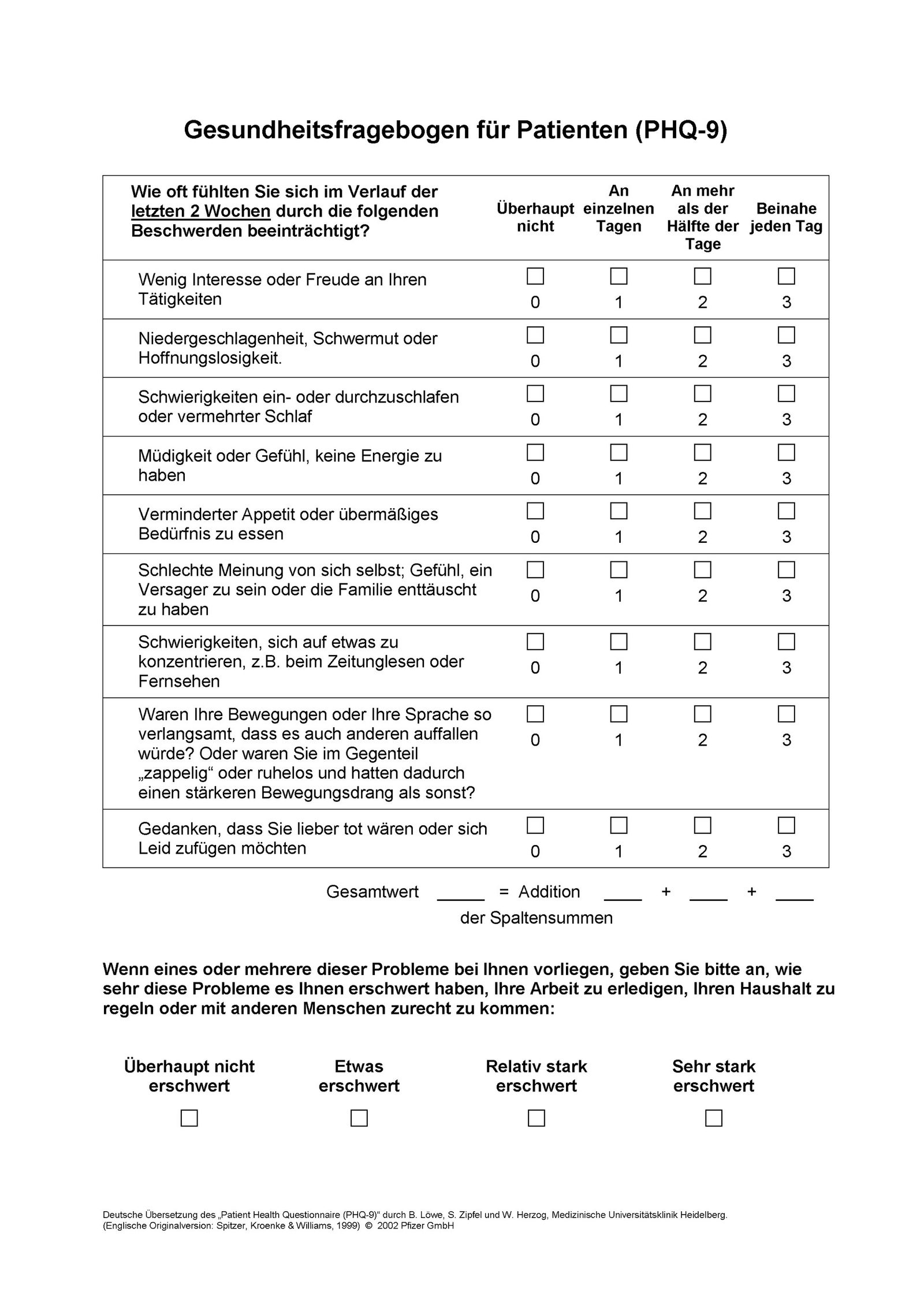
The PHQ-9 is the most widely used depression screening instrument in primary and secondary care, and it appears in clinical practice, quality-improvement work, and psychiatry exams with equal regularity. Nine questions, a 0–27 score, and a handful of cutoffs — but the interpretation carries real consequences, from routine monitoring to same-day risk assessment. This guide covers PHQ-9 scoring and interpretation item by item, the severity bands examiners expect you to know, and where the instrument's limits begin.
Developed by Spitzer, Kroenke and Williams and validated in 2001, the PHQ-9 queries how often each of the nine DSM depression symptoms has bothered the patient over the previous two weeks — the same two-week window the DSM-5-TR criteria for a major depressive episode use.
The nine items and what they map to
Each item is scored 0 (not at all) to 3 (nearly every day):
- Anhedonia — little interest or pleasure in doing things
- Depressed mood — feeling down, depressed, or hopeless
- Sleep disturbance — trouble falling or staying asleep, or sleeping too much
- Fatigue — feeling tired or having little energy
- Appetite change — poor appetite or overeating
- Worthlessness — feeling bad about yourself, or that you are a failure
- Concentration trouble — trouble focusing on things, such as reading
- Psychomotor change — moving or speaking noticeably slowly — or being fidgety/restless
- Self-harm ideation — thoughts that you would be better off dead, or of hurting yourself
Items 1 and 2 are the cardinal mood symptoms; together they map directly onto the DSM-5-TR requirement for depressed mood or anhedonia. Item 9 is the safety item and is handled differently from the rest — more on that below.
Scoring and severity bands
Add the nine responses for a total of 0–27. The conventional interpretation bands are:
| Total score | Severity | Typical interpretation and action |
|---|---|---|
| 0–4 | Minimal / none | No depression likely; no treatment indicated. Re-screen at routine intervals. |
| 5–9 | Mild | Subthreshold symptoms. Watchful waiting, reassess in 2–4 weeks; consider brief counselling or behavioural activation. |
| 10–14 | Moderate | Treatment threshold for many guidelines. Confirm diagnosis with a structured interview, then start treatment (e.g. CBT or an SSRI) and re-screen. |
| 15–19 | Moderately severe | Active treatment indicated; assess functional impairment and consider combination psychotherapy + pharmacotherapy. |
| 20–27 | Severe | Treatment urgent; evaluate for psychosis, bipolar features, and suicidality, and consider specialist referral. |
After the score, always read the two supplementary questions the instrument includes: how difficult the symptoms make work, home, or relationships ("not difficult" → "very difficult"), and item 9. A score of 12 with marked functional impairment is a different clinical situation from a score of 12 the patient shrugs off.
Exam trap
Any non-zero response to item 9 — even "several days" — requires a direct follow-up assessment of suicidal ideation, plan, intent, and means before the patient leaves. Examiners frequently offer "schedule a follow-up in two weeks" as the tempting wrong answer; the safe, correct next step is an immediate risk assessment. Item 9 also means the PHQ-9 screens severity and flags risk — it is never just a number.
Using the PHQ-9 well — and its limits
It is a screening and monitoring instrument, not a diagnosis. A score ≥10 supports further diagnostic evaluation; it does not establish major depressive disorder. Differential diagnoses — bipolar disorder, adjustment disorder, grief, substance effects, medical causes (hypothyroidism, B12 deficiency, obstructive sleep apnoea)— still require clinical assessment. Screening for bipolar features before starting an antidepressant remains mandatory.
Track change, not just one point. The PHQ-9's real power is serial administration: a 5-point drop is a conventional marker of meaningful improvement, and repeated scores convert vague "feeling better" into data. Many services re-administer at every treatment contact or at fixed 4–12 week intervals.
Known limitations. It under-detects depression in older adults who somatise, may misattribute symptoms to medical comorbidity, and its item 9 conflates passive death wishes with active ideation — which is exactly why the follow-up interview matters. Two-stage screening (a brief PHQ-2 first, the full PHQ-9 only if positive) is an efficient population strategy, but once you are administering the PHQ-9, score it in full every time.
Where the PHQ-9 sits in the guidelines
NICE and multiple national depression pathways recommend routine depression screening in settings where diagnosis and treatment can follow — the trap is screening without a system to act on results. Quality metrics commonly track "percentage of patients with a new depression diagnosis and a follow-up PHQ-9 within 12 months," which is why you will meet the instrument again in clinical governance work long after the exam.
Frequently asked questions
What do PHQ-9 scores of 5, 10, 15, and 20 mean?
They are the severity cutoffs: 5–9 mild, 10–14 moderate, 15–19 moderately severe, and 20–27 severe depression. A score of 10 or above is the usual threshold for further diagnostic evaluation and treatment consideration, and every score of 0 on item 9 must be verified separately for self-harm risk.
Is the PHQ-9 diagnostic for major depressive disorder?
No. It screens for depressive symptoms and measures severity over the previous two weeks. A positive score (commonly ≥10) warrants a diagnostic interview that rules out bipolar disorder, substance-induced symptoms, grief, and medical causes — none of which the questionnaire can distinguish.
How often should the PHQ-9 be repeated?
At each treatment contact or every 4–12 weeks depending on the service, and at every follow-up for patients starting treatment. A change of about 5 points is generally considered clinically meaningful, so serial scores are far more informative than a single result.
What should I do if item 9 is positive?
Conduct an immediate, direct risk assessment covering ideation, plan, intent, means, and protective factors. Escalate to urgent psychiatric evaluation when there is intent or a plan; otherwise document a collaborative safety plan with means restriction and clear follow-up. Never close the questionnaire with item 9 unanswered or unaddressed.
Key takeaways
- PHQ-9 = 9 items × 0–3 over two weeks; total 0–27, cutoffs at 5 / 10 / 15 / 20.
- ≥10 is the working threshold for further evaluation and treatment consideration.
- Item 9 (self-harm) always triggers an immediate risk assessment — no exceptions.
- Screening ≠ diagnosis: rule out bipolar, substance, grief, and medical mimics first.
- Serial scores are the point — track a ~5-point change as meaningful response.
- Always read the functional-impairment question alongside the numeric total.
Turn these cutoffs into automatic recall with Preppsy's spaced-repetition psychiatry flashcards, or practise interpretation in context with a mock exam.
Cover image: “Gesundheitsfragebogen PHQ-9.tif” by WissMitUKE (CC BY-SA 3.0) via wikimedia commons.